Recipes for making sunscreen at home are among the most popular content in this category. The problem with them is not that the ingredients are wrong. Several recipes use exactly the right filter. The problem is that everything which converts a filter into protection is missing.
The core problem, in one paragraph
Protection is delivered by a film in which filter is distributed evenly at a scale far below what the eye can see. A dense inorganic powder does not distribute itself. It has to be wetted, separated, held apart against its own tendency to clump, and suspended so it stays that way. Industry does this with surface treated raw materials, high shear dispersion, pre made dispersions and analysis. A kitchen has a bowl and a spoon. What comes out looks mixed and is not, at the scale that matters, and there is no way to tell from looking.
The five things that cannot be verified at home
Dispersion uniformity
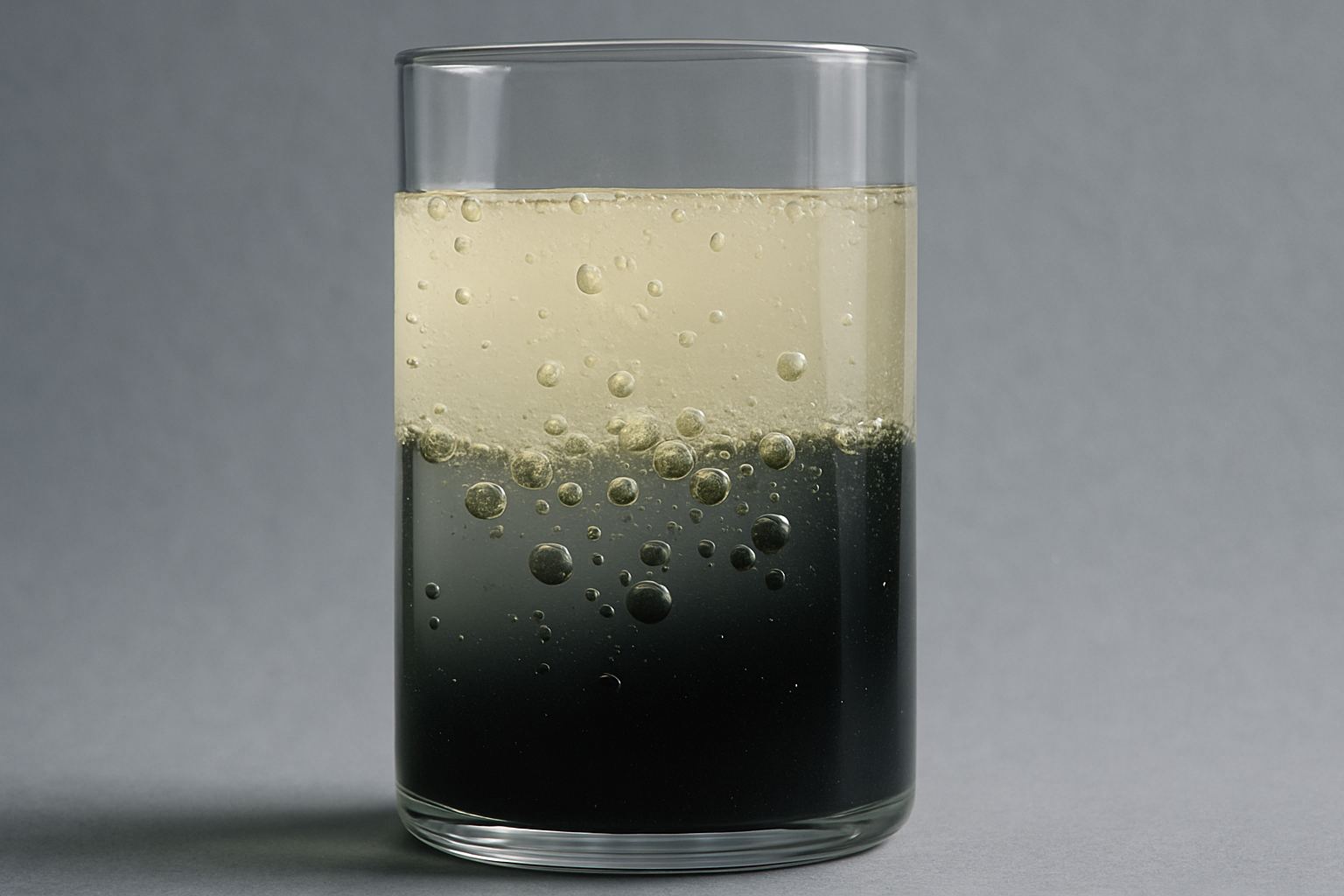
Agglomerated particles behave optically like large particles: they cover less area per unit mass and they leave gaps. A homogeneous looking paste can be full of agglomerates. Confirming otherwise requires microscopy.
Protection
Sun protection factor is determined in vivo, on human volunteers, under a standard method, at a specified application density, in a laboratory. It cannot be calculated from the proportion of powder in a recipe, because protection depends on dispersion, film formation and coverage, not on the mass of filter present. Any recipe that states a factor is stating something nobody has measured.
Preservation
Anything containing water supports microbial growth. Preservative systems are chosen and then verified by challenge testing, in which the product is deliberately inoculated and the survival of the organisms is measured. An unpreserved or arbitrarily preserved emulsion applied to skin, kept in a warm bathroom or a beach bag, and repeatedly touched with fingers, is a straightforward microbiological problem.
Stability
Emulsions separate, suspensions settle, oils oxidise, pH drifts. Industry runs months of stability programmes because these changes take months to appear. A home made product's behaviour after four weeks in a hot car is unknown.
Safety assessment
A cosmetic product placed on the market requires a safety assessment by a qualified assessor, covering the whole formula, the exposure, and the interactions between ingredients. That assessment is a professional judgement based on a documented file. It has no domestic equivalent.
You can make an effective sunscreen at home with zinc oxide
- What would have to be true
- That the zinc oxide can be dispersed evenly enough, at home, to form a film without gaps.
- That the resulting protection can be established, since protection is determined by measurement and not by composition.
- That the product can be preserved, stabilised and assessed for safety.
- What is established
- Zinc oxide is a permitted ultraviolet filter and is available to buy as a powder.
- The filter itself does not stop working because of where it was mixed.
- What is not established
- That domestic mixing achieves the dispersion uniformity that protection depends on.
- That any protection figure can be attached to a home made preparation, since sun protection factor is determined in vivo by a standard method.
- That preservation, stability and safety assessment can be substituted by a recipe.
The inhalation point, which is the most serious one
Scientific assessments of the nanoscale metal oxides advised against applications where the material could be inhaled, and the conditions attached to the regulatory entries reflect that. The reasoning is that the lung has no equivalent of the stratum corneum, so dermal safety conclusions do not transfer to inhalation.
Handling a fine metal oxide powder in an unventilated domestic space, weighing it out and stirring it, generates airborne dust. This is the point in the whole subject where a home made preparation creates an exposure route that commercial products are specifically formulated and regulated to avoid, and it is almost never mentioned in the recipes.
The legal position on sharing or selling
Making something for yourself is your own affair. The moment a product is supplied to another person, including given away free at a market or through a community group, cosmetics law is engaged in full. That means a responsible person, a product information file, a safety assessment by a qualified assessor, compliant labelling, notification before placing on the market, and compliance with the annexes. A product presented as a sunscreen also has to meet the labelling conventions for protection claims, which requires the testing.
Enforcement sits with the Office for Product Safety and Standards and with local authority Trading Standards services. Selling a home made sunscreen without any of this in place is not a grey area.
If you are choosing sun protection for a child, for skin that reacts to commercial products, or after a diagnosis or treatment that affects your skin, that is a conversation for a pharmacist, your GP or a dermatologist. There are compliant options for sensitive skin, and a clinician can help you find one. A home made preparation is not a solution to a clinical problem.
The specific ways the recipes go wrong
Reading a representative sample of circulating recipes, the same handful of errors recur, and they are worth naming because each one destroys protection on its own.
- Uncoated powder. Recipes call for zinc oxide powder without reference to grade or surface treatment. Uncoated material agglomerates readily and, in the case of titanium dioxide, is the photocatalytically active form that commercial products specifically avoid.
- Melting into a wax base. Stirring powder into melted beeswax and butter produces a suspension that sets as the base cools, freezing whatever agglomeration existed at the moment of setting. Dispersion quality is fixed by the worst moment of mixing.
- A stated factor derived from arithmetic. Several recipes calculate a protection figure from the percentage of powder. There is no method by which that calculation is valid.
- Water in an unpreserved product. Any recipe involving aloe gel, hydrosol, tea or water produces a microbiological substrate with no preservative system and no challenge testing.
- Essential oils for fragrance. Added to a product intended for use in sunlight, over a large area, repeatedly, which is the situation described in essential oils and photosensitivity.
- Reuse of a food container. Storage in a jar dipped into with fingers, kept warm, over a season.
Any one of these is enough. Most recipes contain several.
Taking the motivation seriously
People make their own sunscreen for reasons that are usually sound. They may have reacted to commercial products, they may distrust an ingredient, they may want to know exactly what is on their skin, they may be trying to reduce packaging, or they may simply enjoy making things. None of that is unreasonable.
The difficulty is that sunscreen is one of the very few cosmetic categories where the outcome cannot be assessed by using the product. A moisturiser that does not work feels wrong. A cleanser that does not work leaves you dirty. A sunscreen that does not work feels exactly like one that does, until the following morning, and the more serious consequences do not appear for decades. Home production works best where feedback is fast, and this is the category where feedback is slowest.
What is reasonable to make at home
Balms, body oils, salves, scrubs, bath preparations and anhydrous butters are all made domestically by many people with no particular hazard, provided they are used personally, kept clean and dry, and made in small quantities. The risks are manageable and the outcomes are assessable.
A protective product whose effectiveness can only be established by a laboratory determination is a different case, and the difference is not about skill or care. It is about what a person can find out.