
Three processes are routinely confused in explanations of sun protection: absorption, scattering and reflection. They are different physics, they have different consequences, and the confusion between them has produced a picture of mineral sunscreen that is memorable, tidy and wrong in its central claim.
What has to be stopped
Ultraviolet radiation reaching the ground is conventionally divided into ultraviolet B, roughly the shorter wavelengths in the ultraviolet range that reach the surface, and ultraviolet A, the longer wavelengths that extend up to the edge of the visible. Ultraviolet B is far more energetic per photon and is the dominant cause of sunburn and of direct damage to DNA. Ultraviolet A is much more abundant at ground level, penetrates further into the dermis, and drives oxidative damage and photoageing, with a contribution to carcinogenesis. A filter that stops one and not the other leaves a real gap, which is why broad spectrum requirements exist.
The design problem is therefore not to block light. It is to remove energy across a defined wavelength band, in a thin layer, without removing visible light, without irritating skin, and while surviving hours of sunlight, sweat and abrasion.
Absorption
Absorption is the transfer of a photon's energy into a material. In an organic filter the mechanism is molecular. The filter molecule contains a conjugated system, typically aromatic rings with attached groups that push and pull electron density. A photon of the right energy promotes an electron from the ground state into an excited state. The molecule then has to lose that energy. In a well designed filter it does so quickly and non destructively, usually as heat, sometimes by rotating around a bond, sometimes by shifting a hydrogen atom between two positions in what chemists call excited state proton transfer. The molecule returns to the ground state and is available to absorb again.
The shape of a filter's absorption spectrum is a property of its electronic structure. This is why one filter peaks in the ultraviolet B and another in the long ultraviolet A, and why formulators combine them: no single organic filter covers the whole range well.
In a metal oxide the mechanism is a solid state analogue of the same thing. Zinc oxide and titanium dioxide are semiconductors. A photon with energy above the band gap promotes an electron from the valence band to the conduction band, leaving a positively charged hole. Because the band gap corresponds to a wavelength in the ultraviolet, both oxides absorb ultraviolet and transmit visible light. Zinc oxide's band gap places its absorption edge further into the ultraviolet A than titanium dioxide's, which is why zinc oxide gives more even long wave coverage and titanium dioxide is stronger in the ultraviolet B and short ultraviolet A.
Absorbing organic filters, by family
Cinnamates and salicylates; dibenzoylmethanes; benzotriazoles and triazines; sulfonic acid derivatives; camphor derivativesCarbon based molecules with conjugated electron systems, dissolved in the oil or water phase of the product.
Absorb ultraviolet photons across a spectrum set by their electronic structure, then dissipate the energy, usually as heat.
No single molecule covers the full range. Some are photolabile and must be stabilised. Solubility limits how much can be loaded before crystallisation.
Long term systemic exposure at realistic use for the smaller, more absorbable members. Environmental fate for those detected in surface water.
Scattering
Scattering is the redirection of radiation by particles. It is not absorption: the energy is not taken into the material, it is sent in another direction, and if it is sent forward into the skin it has not been removed at all.
How strongly a particle scatters depends on its size relative to the wavelength, and on the contrast in refractive index between the particle and the medium around it. When the particle is much smaller than the wavelength, scattering falls away very steeply as the particle shrinks. When the particle is comparable to the wavelength, scattering is strong and roughly forward directed. This is the whole physics of the white cast, treated properly in the white cast problem.
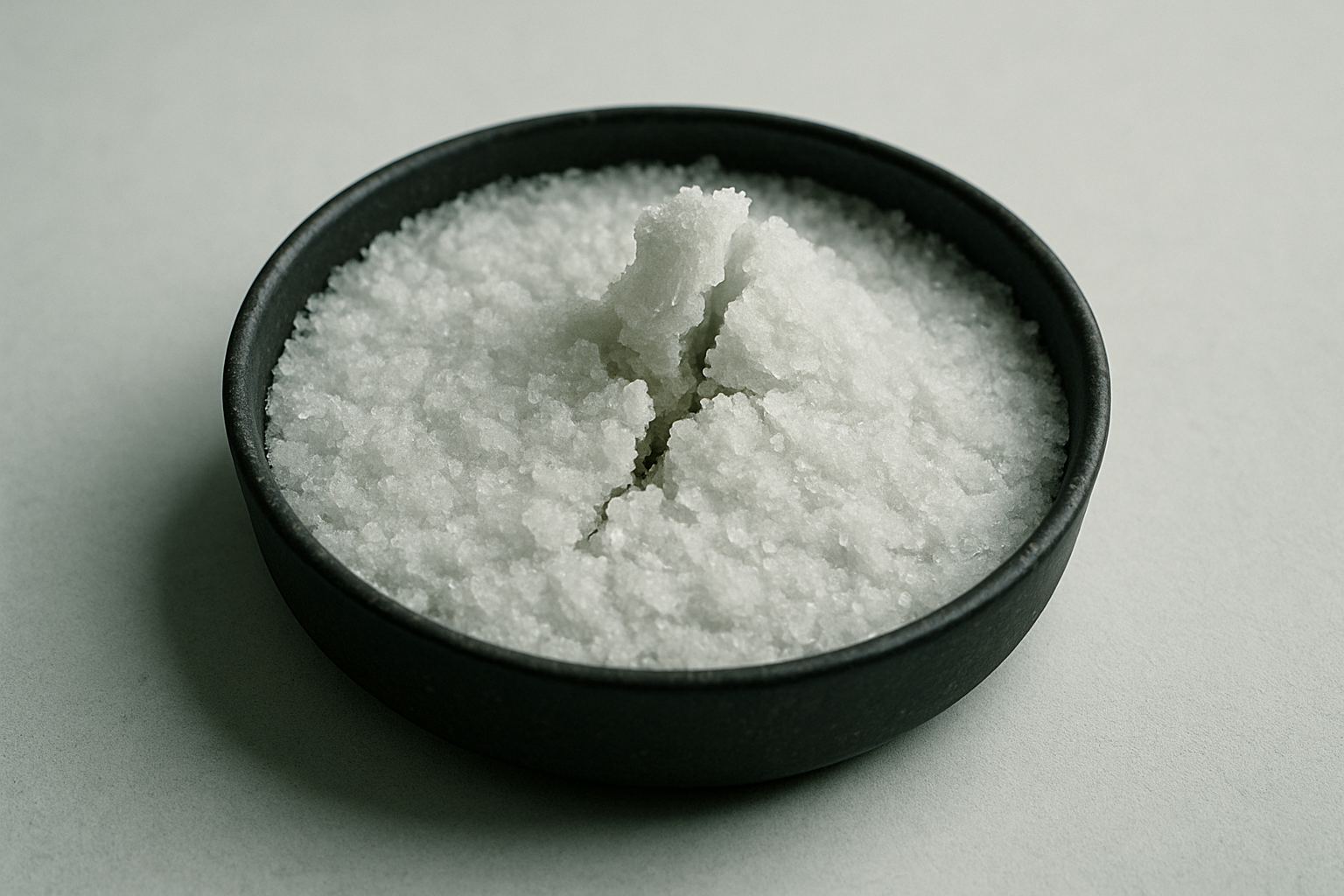
Both metal oxides have a high refractive index compared with the oils and waxes around them, which is why they scatter at all, and why titanium dioxide, with the higher index of the two, is a white pigment in paint. Larger particles scatter visible light strongly and look white. Smaller particles scatter visible light very weakly and look transparent, while still absorbing ultraviolet across the band gap.
Reflection
Reflection in the everyday sense means a mirror: an ordered surface returning radiation at a defined angle. A layer of irregular particles a fraction of a micron across, spread unevenly over a rough biological surface, is not a mirror. Diffuse backscatter is a form of reflection, but it is a modest part of what a mineral film does.
Mineral sunscreen sits on top of the skin and reflects UV like a mirror
- What would have to be true
- That the dominant attenuation mechanism for zinc oxide and titanium dioxide films is reflection or backscatter rather than absorption.
- That the particle layer forms a sufficiently ordered, continuous surface for specular reflection to occur.
- What is established
- The metal oxides are semiconductors that absorb ultraviolet across their band gap, and published measurement of metal oxide sunscreen films has reported that attenuation is dominated by absorption, with reflection and scattering contributing a minor share.
- Scattering does occur, and its magnitude depends strongly on particle size.
- What is not established
- That reflection accounts for most of the protection.
- That the mirror picture explains any observed difference in performance, feel or safety between the classes.
Why the correction matters
It matters for three reasons, none of them academic.
First, the mirror picture is used to argue that mineral filters do not react with anything and therefore cannot degrade or cause a reaction. If the mechanism is absorption, then energy is being taken into the particle and has to go somewhere, which is why photocatalysis is a real design consideration for titanium dioxide and why sunscreen grades are coated. That is covered in what titanium dioxide does.
Second, the mirror picture implies that a mineral product works the moment it is on, which encourages thin application. A particulate film protects in proportion to how completely it covers, and coverage is exactly what a thin layer of particles lacks.
Third, it obscures the actual reason mineral formulations are difficult, which is not chemistry but geometry. A dissolved filter spreads with its solvent. A particulate filter has to be distributed by the formulator's film formers and by the wearer's fingers, and gaps in that distribution are gaps in protection.
The film is the product
Whichever class of filter is used, the thing that protects skin is a film: a thin, continuous, adherent layer with filter distributed through it. Formulators spend most of their effort on the film rather than on the filters, because a filter that is not evenly present does nothing. Film formers, emollients that resist being rubbed away, and polymers that hold particles apart all exist for that reason. When a product performs below the number on its label in real use, the film is usually where it failed.
Because protection depends on film continuity, the quantity applied changes the result more than the choice of filter class does. This is dealt with in the mineral section, where the white cast of a metal oxide product and the tendency to apply it thinly are directly connected.
Where the energy goes
A common follow up question is whether an absorbing filter heats the skin. The energy absorbed in a sunscreen film is small compared with the infrared load from sunlight falling on skin, and it is released across the film rather than at a point. Sunscreen does not make skin measurably hotter in the way that standing in the sun does. The more interesting version of the question, for photostable filter design, is whether the excited state finds a non destructive route back to the ground state, which is the subject of photostability.