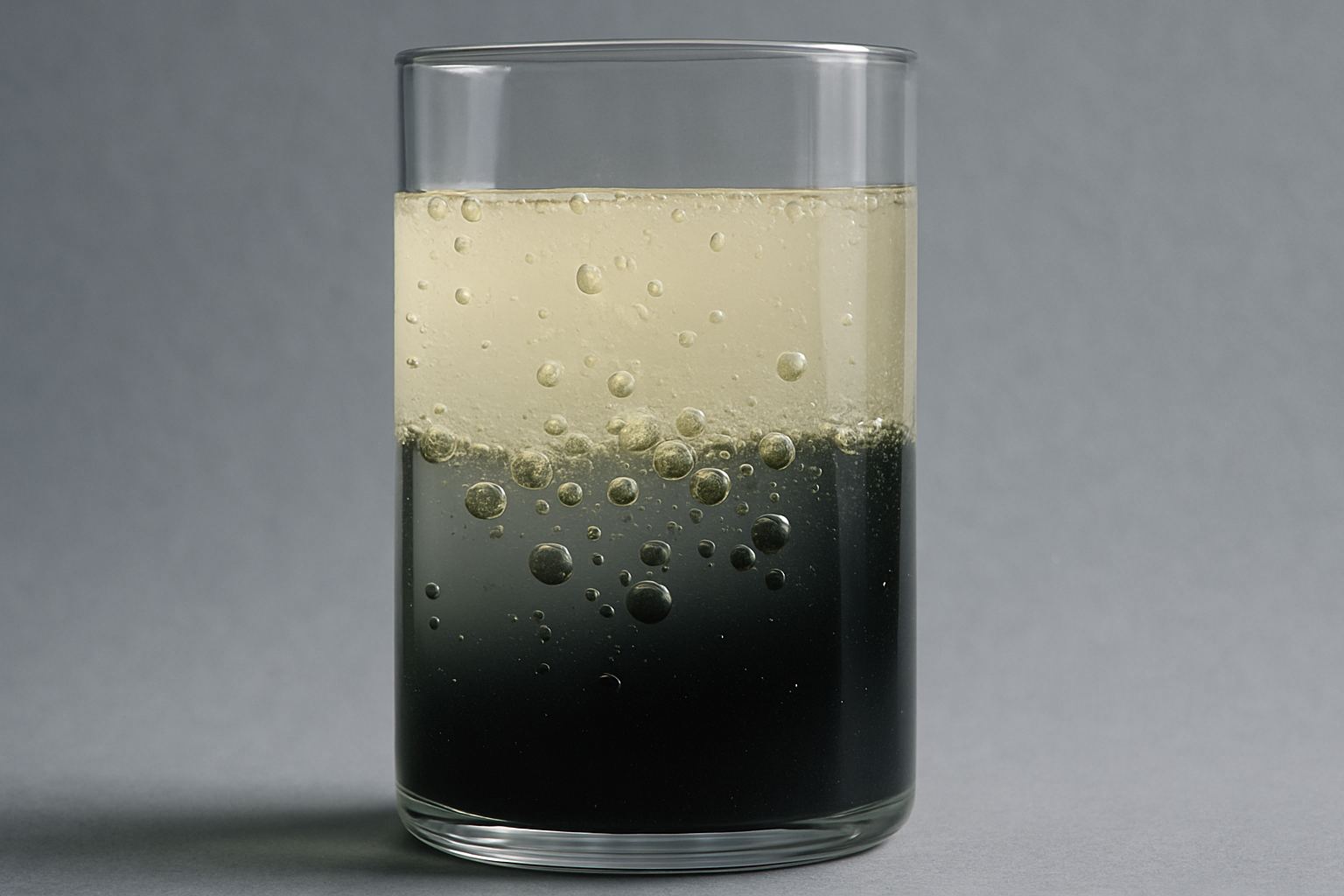
Photostability is the least glamorous property of a sunscreen and one of the most consequential. A product that protects at the moment of application and less an hour later is not doing what its label says, and the wearer has no way to notice until the damage is done.
What photodegradation is
An organic UV filter absorbs a photon and enters an excited electronic state. From there it has to return to the ground state. There are good routes and bad ones. The good routes convert the energy into heat or into a harmless rearrangement, leaving the molecule intact and ready to absorb again. The bad routes involve breaking a bond, reacting with oxygen, or transferring energy to another molecule that then reacts. Each time that happens, one filter molecule stops being a filter.
The extent to which this matters differs enormously across the permitted list. Some organic filters are extremely robust and lose very little absorbance over hours of simulated sunlight. Others are notably photolabile: dibenzoylmethane chemistry, which provides some of the best long wave ultraviolet A coverage available, is well known to degrade appreciably under irradiation when it is used alone.
How formulators deal with it
They combine. A photolabile filter is paired with a partner that accepts the excited state energy and disposes of it safely, or with an antioxidant network, or with a solvent that changes the balance between the molecule's tautomeric forms and favours the stable one. This is standard practice and it is why a competent product's ingredient list contains several filters rather than one. It is also why comparing products by counting filters is meaningless: a formula with five filters may be using three of them to keep the other two working.
Photolabile organic filters and their stabilisation
Butyl methoxydibenzoylmethane and related dibenzoylmethanesThe principal long wave ultraviolet A absorbers among the smaller organic filters, with a strong absorption peak well into the ultraviolet A range.
Provide ultraviolet A coverage that is difficult to achieve with other small molecules, which is why they remain widely used.
Degrade appreciably under irradiation when used without support. Also subject to interactions with certain other filters, so combinations are chosen deliberately.
The extent to which stabilisation measured in vitro corresponds to performance on skin over a long day, and how much of the loss is degradation rather than film disruption.
Where the metal oxides sit
Zinc oxide and titanium dioxide do not photodegrade in the molecular sense. They are crystalline inorganic solids. There is no bond to break in the way a dibenzoylmethane has a bond to break, and the absorption is a bulk electronic property of the crystal rather than a property of an individual molecule that can be lost. Under continuous irradiation, a metal oxide's ultraviolet absorbance does not fall away.
This is a real advantage and the category is entitled to claim it, in those terms. What it is not entitled to claim is that a mineral product therefore maintains its protection through a day at the beach. Protection is delivered by a film, and films fail for reasons that have nothing to do with the filter's molecular integrity.
Mineral sunscreen does not break down in the sun, so it lasts longer
- What would have to be true
- That the dominant cause of protection loss during wear is photodegradation of the filter.
- That a filter which does not photodegrade therefore delivers protection for longer in real use.
- What is established
- Metal oxide filters do not photodegrade in the molecular sense, and their ultraviolet absorbance is stable under irradiation.
- Some organic filters are photolabile when unsupported, which is why formulations stabilise them.
- What is not established
- That photodegradation is the main route by which a sunscreen film loses effectiveness in use. Rubbing, sweating, towelling, sand abrasion and simple redistribution of a particulate film all remove protection regardless of filter class.
- That any product, mineral or otherwise, should be renewed less often on this basis. Reapplication guidance is not built on filter photostability.

How a film actually fails
Set photostability aside and look at what happens to a real film over four hours.
- Mechanical removal. Clothing, towels, seats, sand and hands take film off. Towelling is the single most effective way to remove a sunscreen film that has been devised.
- Sweat and water. Water resistant formulations resist redispersion of the film, but resistance is not permanence, and water resistance is assessed under a defined protocol rather than under a day of use.
- Redistribution. A particulate film can migrate into skin creases and around hair follicles, thinning where it is needed. This affects metal oxide products specifically, since a dissolved filter moves with its solvent rather than settling.
- Agglomeration. Fine metal oxide particles tend to clump. Clumped particles scatter more visible light and cover less area per unit mass, so both whiteness and gaps increase.
- Sebum and moisture. The film sits on a surface that is producing oil and water. Over hours, that changes the film's structure.
Every one of those applies to mineral formulations, and several apply to them more strongly than to organic filter formulations.
The titanium dioxide complication
There is a second sense of stability that runs the other way. When titanium dioxide absorbs a photon and generates an electron and a hole, those charge carriers can reach the particle surface and drive redox chemistry with adsorbed water and oxygen, producing reactive oxygen species. This is photocatalysis, and it is the basis of an entire industry in self cleaning surfaces and water treatment. It is not something you want happening on skin or inside a formulation.
The industry deals with it by using the less photocatalytically active crystal form and by coating particles with inert layers of silica, alumina, or silicone materials. This is standard, it is required by the conditions attached to the relevant regulatory entries, and it works. But it means that a mineral filter is not chemically inert in the way the marketing implies, and it means that coating integrity is a genuine quality variable. This is developed in what titanium dioxide does.
Even a metal oxide only formula usually contains both oxides, because their absorption spectra are complementary and because titanium dioxide can help lift the sun protection factor while zinc oxide extends coverage into the long ultraviolet A. Formulating with one filter is possible and is rarely the best available answer.
What to take from this
Photostability is a property of a formulation and not of a filter class alone. The metal oxides bring genuine molecular stability and bring a photocatalysis question that has to be engineered around. The organic filters include both very stable and quite labile members, and a competent formulator handles the labile ones by design. In both cases, the practical determinant of whether you are still protected at four in the afternoon is how much you applied, what has rubbed it off since, and whether you renewed it. Renewal advice does not change with the filter class you chose, and the general guidance from the NHS and from Cancer Research UK applies to mineral products exactly as it does to any other.