The mineral and organic division is the first thing a shopper meets and the last thing most explanations get right. It is a real distinction. It is a distinction about physical state and chemical class, and it carries fewer consequences than the category built on top of it suggests.
What actually differs
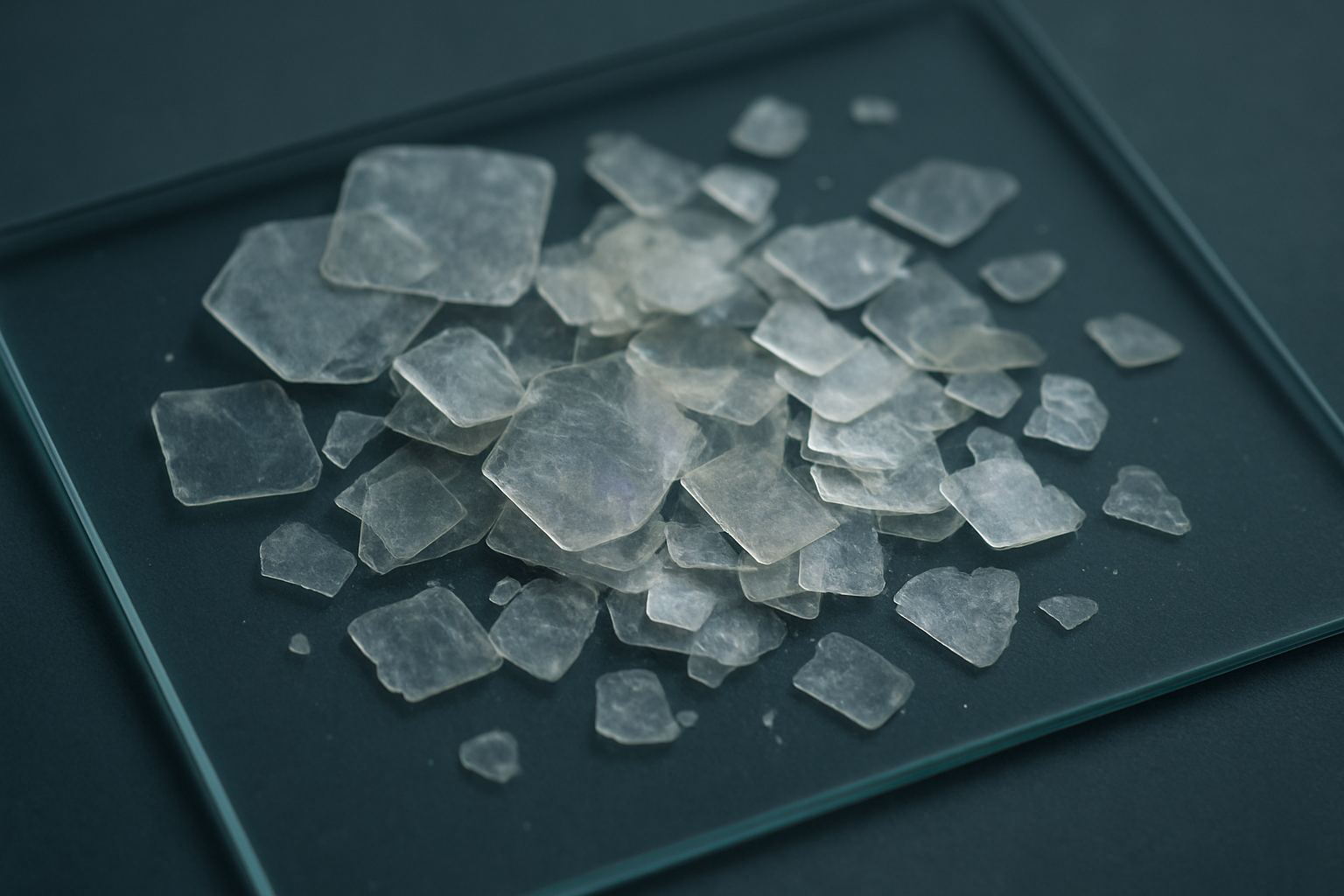
A mineral filter is a solid. Zinc oxide and titanium dioxide are crystalline inorganic solids that do not dissolve in the oils or water of a cosmetic formula. They are milled, surface treated and dispersed, and they remain particles from the mixing vessel to the skin. On skin they form a layer of discrete particles held in place by whatever film formers the chemist has put around them.
An organic filter is, in almost every case, dissolved. It goes into the oil phase or the water phase as a molecule, and it stays there. On skin it is distributed through a continuous film of oils, waxes and polymers. Nothing is suspended; there is nothing to settle out or agglomerate.
From that single difference, a long list of practical consequences follows, and none of them is a moral property.
| Property | Mineral filters | Organic filters |
|---|---|---|
| Physical state in the product | Solid particles in suspension | Molecules in solution |
| Film on skin | Particulate, uneven at the microscopic scale | Continuous, follows the skin surface |
| Optical behaviour | Absorb, and also scatter visible light in proportion to particle size | Absorb; negligible visible scattering |
| Typical failure mode | Settling, agglomeration, whiteness, drag on application | Photodegradation of some molecules, penetration questions for the smaller ones |
| Formulation difficulty | High: dispersion stability, rheology, gritty feel | Moderate: solubility limits, crystallisation, compatibility |
| Effect on the rest of the formula | Large. Changes viscosity, pH behaviour, preservative demand | Smaller. Mostly a solubility problem |
The words themselves are unhelpful
Organic here means carbon based. It has nothing to do with organic farming, organic certification or organic agriculture, and the collision of the two senses in a category that also sells organic ingredients is a permanent source of confusion. Meanwhile mineral is not a term of art in cosmetic chemistry at all. It has been adopted because it is a friendly word for two industrially produced metal oxides, neither of which is dug out of the ground and put in a jar.
That is worth dwelling on. Cosmetic grade zinc oxide is manufactured, most often by vaporising zinc metal and oxidising it in air, then milling and surface treating the resulting powder to a controlled particle size distribution. Cosmetic grade titanium dioxide comes from processing titanium ores through a chloride or sulphate route to a purified pigment, then coating it. Both are minerals in the sense that they are inorganic crystalline solids. Neither is a natural product in the sense a shopper would assume from the word.
Mineral filters are natural and chemical filters are synthetic
- What would have to be true
- That the metal oxides used in sunscreens are obtained from nature in something close to the state in which they are used.
- That the two classes differ in origin rather than in chemical family.
- What is established
- Both metal oxides used in sunscreens are industrially manufactured to controlled particle size, purity and surface treatment. Neither is a mined material used as found.
- Both classes are produced by chemical process industries, and the ingredient lists of both are drawn from the same regulatory annex.
- What is not established
- That mineral filters have a natural origin in any sense that would distinguish them from the organic filters.
- That the origin of a filter tells you anything about how it behaves on skin.
What does not follow from the difference
It does not follow that one class is safer
Safety in cosmetics is assessed substance by substance and product by product, not class by class. Every permitted filter has been through a dossier. Some entries have been amended downward as data accumulated, and that has happened to organic filters and has been considered for the nanoscale forms of the metal oxides. A class level safety claim is not something the regulatory system produces, because the regulatory system does not work at class level. This is examined directly in is mineral sunscreen safer.
It does not follow that one class performs better
Sun protection factor and ultraviolet A protection are properties of finished products, measured on skin or on a substrate by standard methods. A well made formula in either class can reach a high labelled protection. A poorly made one in either class can fail. The determinant is formulation quality and, on the wearer's side, how much is applied and how it is renewed.
It does not follow that one class is kinder to skin
The perception that mineral is gentler has a plausible mechanism behind it and weaker evidence than the perception implies. It is treated separately in is mineral better for sensitive skin, where the distinction between irritation, allergy and simple discomfort turns out to do most of the work.
It does not follow that one class is better for the sea
The environmental argument has become the strongest driver of the category and is the weakest supported. It is taken apart in the environment section, including the point that inorganic particles are not inert once they are in water.
How each class is actually made
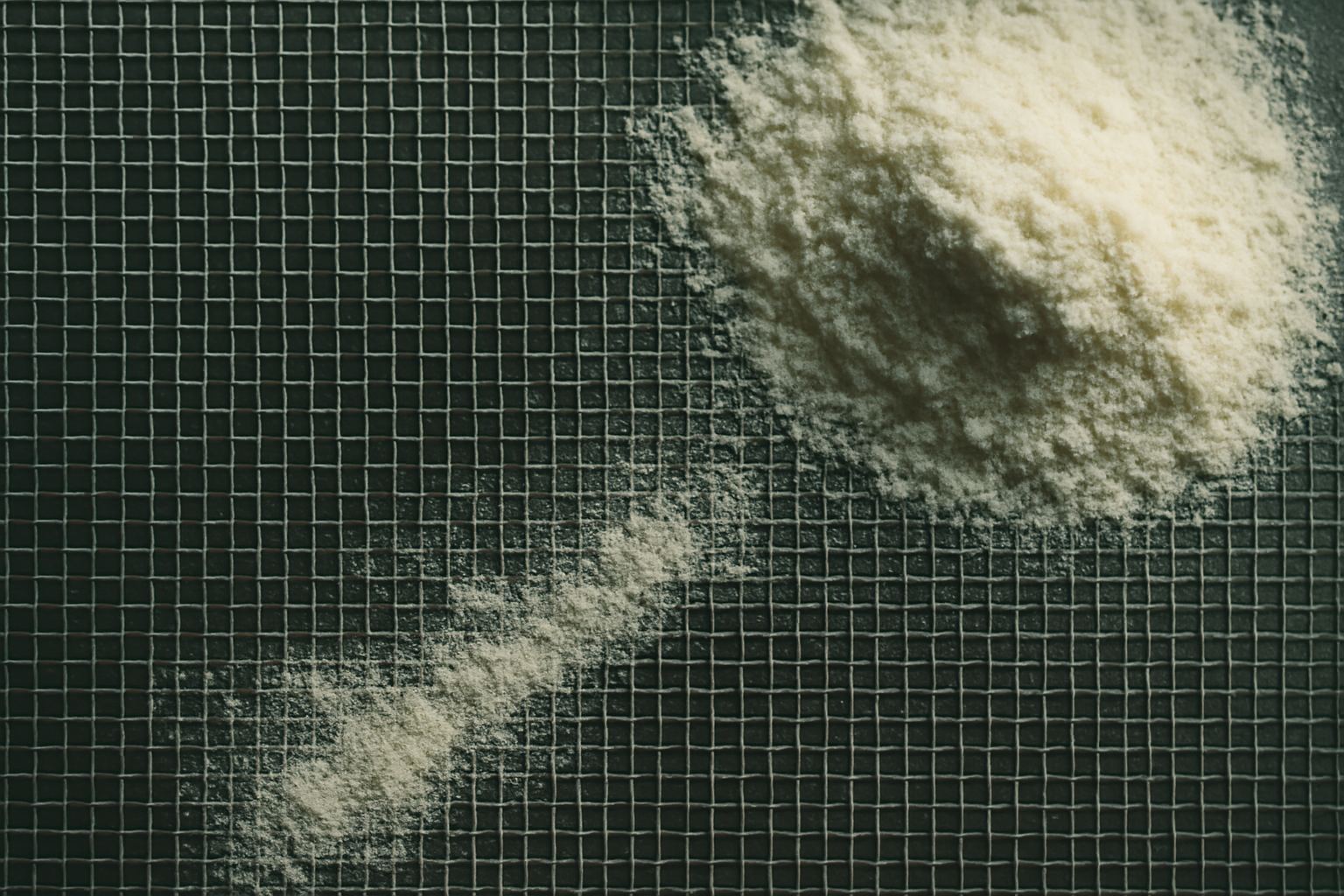
The manufacturing routes are worth knowing, because they dispose of the origin story quickly. Cosmetic grade zinc oxide is most often made by the French process: zinc metal is vaporised in a furnace, the vapour is oxidised in air, and the resulting powder is collected, classified and milled to a controlled particle size distribution. It is then surface treated, commonly with silica, alumina, a silicone material or a fatty acid salt, to stop particles clumping and to make them wettable by the oil phase they will live in. A supplier will specify the primary particle size, the surface area, the coating chemistry and the residual impurity profile, because a formulator needs all four.
Titanium dioxide is produced from titanium bearing ores through either the chloride route, which converts the ore to titanium tetrachloride before oxidising it back to the dioxide, or the older sulphate route. Sunscreen grades are then milled and coated much as zinc oxide is. Both processes are heavy industrial chemistry, run at scale, with quality control on particle size that is far tighter than anything a plant extract is subject to.
The organic filters are made by conventional synthetic organic chemistry: coupling reactions, condensations, esterifications, followed by purification and specification against an impurity profile. Some of the modern broad spectrum molecules are large and structurally elaborate, which is a design feature rather than an accident, because size is one of the reliable ways to keep a molecule out of the living layers of skin.
Nothing in either route corresponds to the picture of a mineral gathered from the earth and a chemical brewed in a vat. Both are manufactured to specification, and the specification is the reason either can be used at all.
Hybrids, and why they exist
Many formulations combine both classes, and a formulator who is not selling a category story will usually want to. Combining a metal oxide with an organic filter lets a chemist cover the spectrum efficiently, keep total filter loading down, and use the organic filter's solubility to carry protection into parts of the film where particles are sparse. The result is often more elegant than a metal oxide only formula at the same labelled protection.
Products marketed as mineral usually forgo that, not for a performance reason but for a positioning reason. That is a legitimate commercial choice. It becomes a problem only when the marketing implies the choice was made on safety grounds that the evidence does not support.
When a claim distinguishes the two classes, ask which of the three things it is actually about: the physical state of the filter, its chemical family, or its origin. The first is real and consequential. The second is real and mostly irrelevant to a wearer. The third is largely a marketing construction.
Stating it plainly
If you prefer a mineral formulation, there are defensible reasons: you may find the particulate film less irritating on your own skin, you may prefer to avoid a filter whose entry has been amended, you may want a product for a child whose skin you would rather not experiment on, you may simply like the finish. None of those requires the belief that one class of filter is chemically pure and the other is contamination. The category would be more credible if it argued from the reasons that hold rather than the ones that do not.