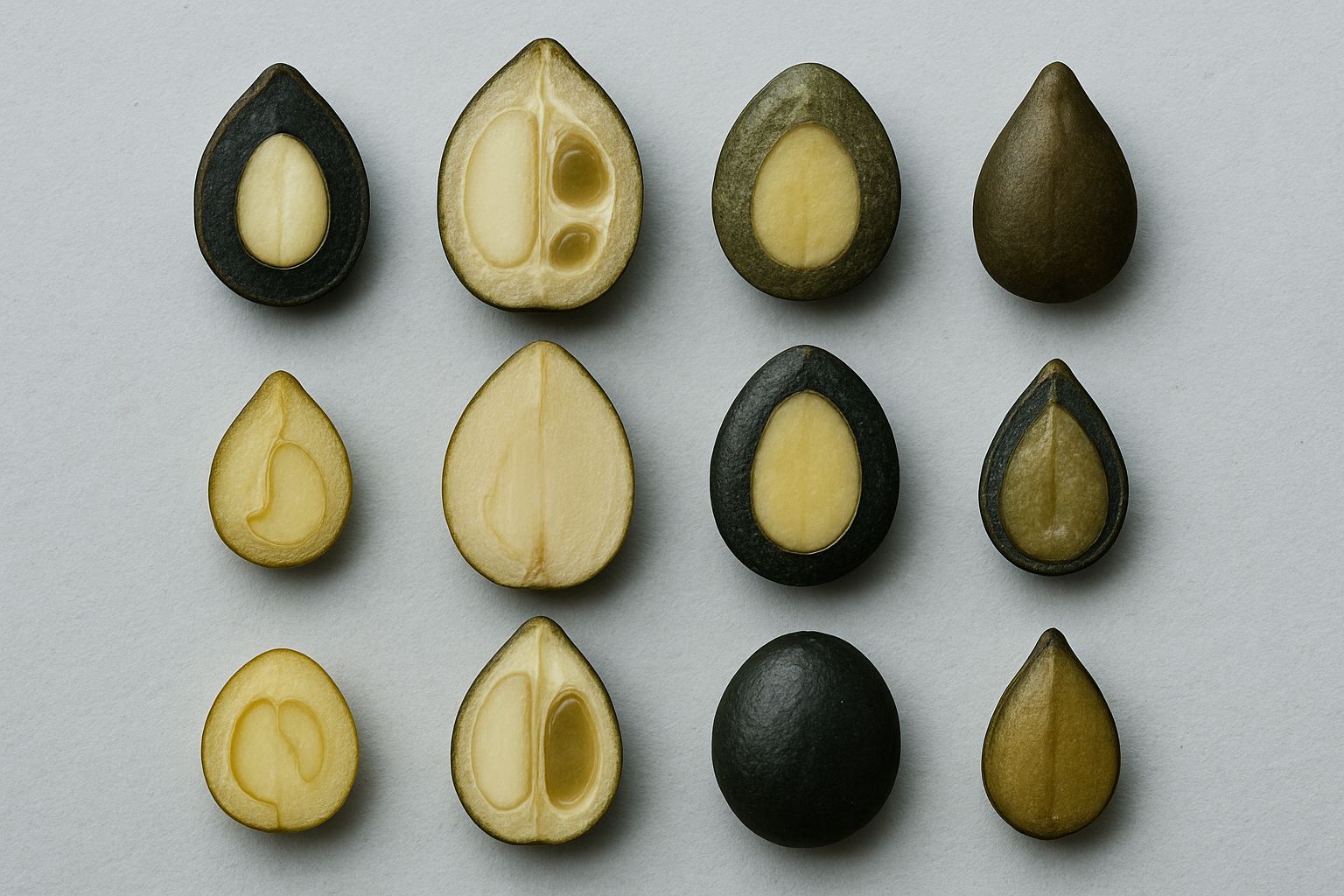
Raspberry seed oil is the claim's second pillar, and unlike carrot seed oil it is usually described with a broad spectrum implication attached. That makes it worth examining separately, because the broad spectrum version of the claim requires more, not less.
What the material is
Red raspberry seed oil is a fixed oil pressed from the seeds of Rubus idaeus, usually cold pressed, generally from seed recovered as a by product of juice and pulp processing. Its fatty acid profile is dominated by polyunsaturates, with linoleic acid and alpha linolenic acid making up the bulk, alongside a smaller oleic fraction. It carries a notable tocopherol content, which is the vitamin E family, and some phytosterols and carotenoid traces.
As an emollient this is a genuinely attractive profile. Linoleic acid is a component of the skin's own barrier lipids, and oils with high linoleic content are well regarded for skin barrier support. As a raw material it is a by product of an existing food chain, which is a reasonable point in its favour on resource grounds.
The claim as it is made
It is usually stated with two elements: a numerical sun protection value, and a claim of coverage in both ultraviolet bands, sometimes with an assertion that it is comparable to titanium dioxide. This publication attributes no sun protection value to it and does not repeat the numbers, for the reasons set out in plant oils presented as sun protection.
Red raspberry seed oil provides broad spectrum sun protection comparable to a mineral filter
- What would have to be true
- An absorption spectrum for the oil showing sufficient absorbance across both ultraviolet bands at a realistic film thickness.
- Photostability under irradiation, since a sunscreen is exposed to the radiation it is filtering.
- In vivo determination of protection and of ultraviolet A protection by the recognised methods on a finished product.
- A permitted filter entry, since sun protection factor is a labelling concept applying to sunscreen products.
- What is established
- The oil is a real, well characterised cosmetic material with a high polyunsaturated fatty acid content and a notable tocopherol fraction.
- It is a good emollient with a fatty acid profile relevant to barrier support.
- What is not established
- That an absorption spectrum supporting the broad spectrum claim has been published for the oil at a realistic film thickness.
- That any in vivo determination exists.
- That it is a permitted ultraviolet filter, which it is not.
- That comparison to a metal oxide filter is supportable in either band.
The argument that runs directly against the claim
This is the part of the case that deserves more attention than it gets, because it is not merely an absence of evidence. It is a chemical reason to expect the claim to fail.
Polyunsaturated fatty acids are, by structure, the lipids most susceptible to oxidation. Each doubly allylic position between two double bonds is a site where a hydrogen atom is easily abstracted, initiating a radical chain reaction that propagates through the oil. Ultraviolet radiation, particularly in the presence of oxygen and traces of transition metals, is an efficient initiator of exactly that chemistry.
So the material being proposed as a sunscreen is the class of material most likely to degrade under the conditions a sunscreen exists to withstand. Its tocopherol content is not incidental here: tocopherols are chain breaking antioxidants and are present in such oils precisely because the oil needs protecting from oxidation. They are consumed as they work.
The consequences are practical. An oxidising oil on skin generates lipid hydroperoxides and their breakdown products, which include aldehydes. Oxidised lipids are not benign on skin, and rancidity is not just a smell. A formulator using a high polyunsaturate oil manages this with antioxidants, packaging that excludes light and air, and a realistic shelf life. A person applying it as sun protection is doing none of that, in full sunlight, on purpose.
What the oil is genuinely good for
- Barrier support. A high linoleic content is relevant to the composition of skin barrier lipids, and such oils are well regarded as emollients for that reason.
- Sensory quality. It is a light, fast absorbing oil that improves the feel of a formula.
- Antioxidant contribution. Its tocopherol content contributes to the formula's own oxidative stability.
- Resource profile. Derived from a by product stream of food processing.
A product that used it for those reasons, in a formula whose protection came from permitted filters, would be making no claim that needs defending. That is a perfectly good product and several exist.
Comparing any plant oil to a metal oxide filter compares a material with no permitted filter entry and no in vivo determination against a material with both, a published absorption behaviour and a scientific committee opinion. The comparison is not close and it is not a matter of interpretation.
What would change the assessment
The same list as for any candidate: a defined specification, a published absorption spectrum at stated concentration and path length, photostability data, a toxicological dossier, in vivo determination on a finished product, and an entry on the permitted annex. If that work were done and the results supported the claim, this publication would record it as established. Nothing here is an objection to the oil.
In vitro and in vivo, and why the distinction is the whole argument
Almost every plant oil claim rests on an in vitro measurement, so it is worth being precise about what the two kinds of measurement establish.
An in vitro determination spreads a product on a roughened synthetic substrate designed to imitate the topography of skin, and measures transmission through it with a spectrophotometer. It is fast, it uses no volunteers, and it is genuinely useful for screening formulations during development and for the ultraviolet A measurement, where a standardised in vitro method is the recognised approach. What it does not capture is how a film behaves on living skin: how it settles into creases, how it interacts with sebum and sweat, how it is redistributed by the act of rubbing it in, and how it changes over hours.
An in vivo determination applies the product to human volunteers at a specified density and measures the ultraviolet dose required to produce a just perceptible reddening, compared with unprotected skin. It is slower, more expensive and involves deliberately exposing people to ultraviolet, which is why it is used for the labelled figure and not for casual investigation.
A substance can look promising on a plate and fail on skin, and the failure modes for a thin, migrating, oxidising oil film are exactly the ones a plate cannot see. Presenting an in vitro number as though it were a labelled protection factor is the single most common error in this whole subject, and it is an error about method rather than about botany.
The summary
Red raspberry seed oil is a good emollient with a fatty acid profile that formulators like and a resource story that stands up. As sun protection it is unsupported, the broad spectrum version of the claim is the least supported claim examined on this site, and the oil's own chemistry gives a specific reason to expect it to degrade rather than persist under ultraviolet. Using it as a sunscreen means relying on a material that the sun is actively breaking down.
Guidance on protecting your skin comes from the NHS, Cancer Research UK and the British Association of Dermatologists. If you have burnt, or you are concerned about a change in your skin, contact your GP or a pharmacist.
A note on how to check any of this
Anyone can verify the parts of this that matter. The permitted filter annex is public and searchable, so the absence of any plant oil from it takes about a minute to confirm. The fatty acid composition of common cosmetic oils is documented in food science and cosmetic science literature. The susceptibility of polyunsaturated lipids to oxidation is standard lipid chemistry and appears in any textbook on the subject. None of this requires trusting a website, including this one.