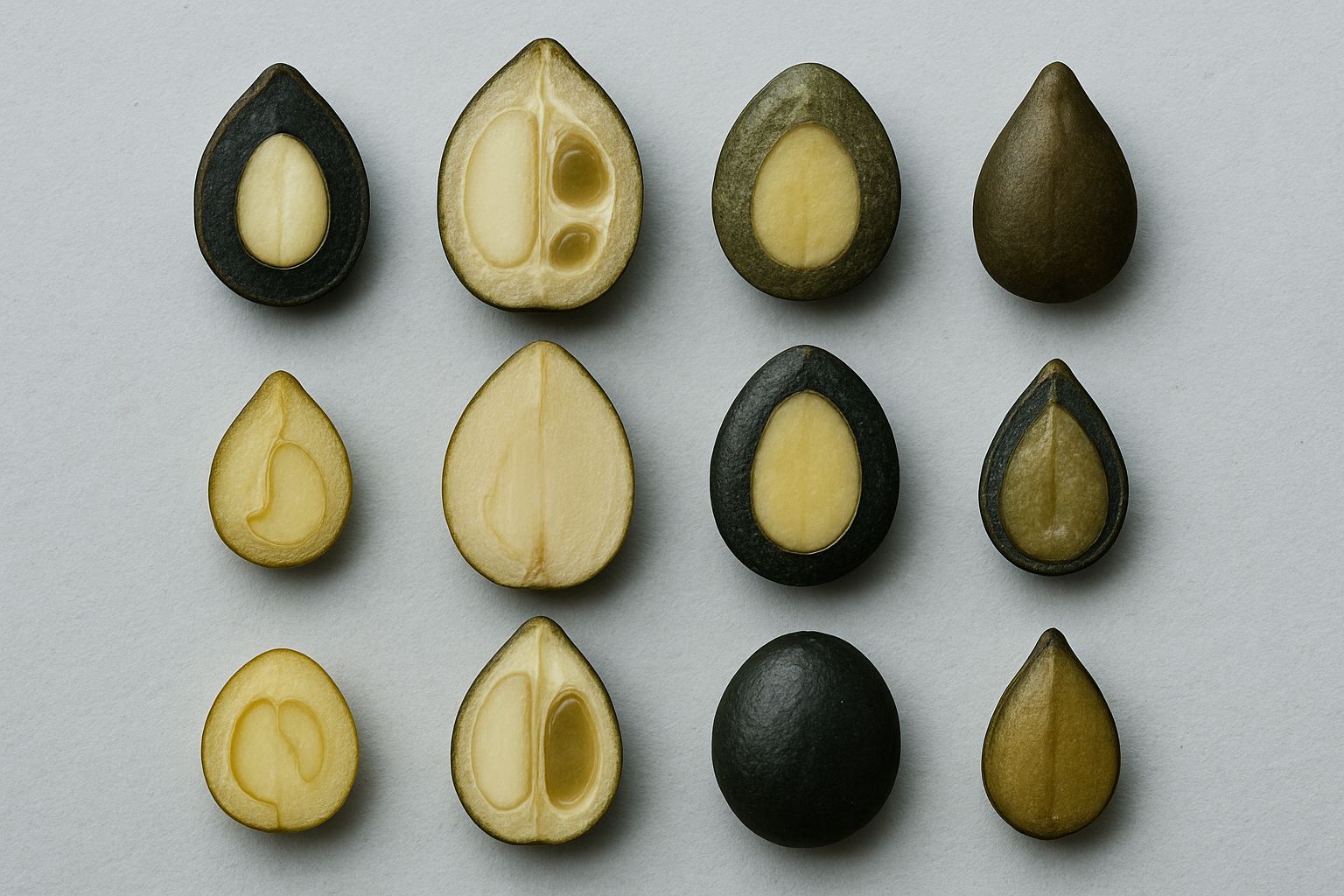
If one ingredient carries the natural sun protection claim, it is this one. It is worth taking seriously enough to examine properly, which means separating the material from the story attached to it.
Two different materials, one name
The confusion begins with nomenclature. At least two distinct products are sold under names that a reader will treat as interchangeable.
- Carrot seed essential oil. Steam distilled from the seeds of Daucus carota. A volatile, aromatic material composed largely of sesquiterpenes, dominated in most analyses by carotol. It is an essential oil, with everything that implies for concentration, sensitisation and handling.
- Carrot root extract in a carrier oil. Carrot root macerated or extracted into a vegetable oil, giving a coloured oil rich in carotenoids. This is a fixed oil preparation, not volatile, and chemically very different from the essential oil.
These are not the same substance and do not have the same composition, the same absorbance or the same safety profile. A claim that does not specify which is being discussed is not a claim that can be assessed, and most claims in circulation do not specify.
What is actually in each
The essential oil is dominated by sesquiterpene alcohols and hydrocarbons. Compounds of that class are not strong ultraviolet absorbers; strong absorbance in the ultraviolet generally requires extended conjugation or aromaticity, and sesquiterpenes largely lack both.
The root extract contains carotenoids, which are strongly conjugated and are genuinely coloured, absorbing in the visible and into the near ultraviolet. Carotenoids do have antioxidant chemistry and there is a substantial literature on dietary carotenoids and skin. That is a different proposition from a topical filter, and carotenoids are also oxidatively unstable in exactly the conditions a sunscreen has to survive.
Carrot seed oil is a natural sunscreen
- What would have to be true
- That a defined material, distinguished from the other product sold under a similar name, absorbs across the ultraviolet range sufficiently in a thin film to protect skin.
- That the protection has been determined in vivo by the recognised method and is reproducible across batches.
- That the material is a permitted ultraviolet filter.
- What is established
- Carrot seed essential oil and carrot root extract are real cosmetic materials with characterised compositions.
- The published figures in circulation trace to a very small evidence base, part of which concerns formulated preparations containing other components.
- What is not established
- That either material is a permitted ultraviolet filter in Great Britain.
- That any in vivo protection determination exists for either.
- That the two materials, which differ chemically, have been distinguished in the claims made about them.
What happens to the citation trail
Following the claim backwards is instructive, and anyone can do it. A retail page cites a wellness article. The wellness article cites another article. That article cites a study. The study, when you reach it, is measuring something narrower than the claim: a formulated preparation, in vitro, on a substrate, with several components present, in a context where the researchers were investigating a formulation rather than certifying an oil.
Nothing improper happened at the start of that chain. The distortion occurred in transmission, and the specific step where it occurred is the attribution of a property of a preparation to one of its ingredients. That step is invalid regardless of the ingredient: you cannot infer the absorbance of a component from the performance of a mixture, because you do not know what the other components contributed.
This publication does not restate the numbers found at the end of that trail. They have already travelled further than their evidence supports.
The side that gets no attention at all
Because the discussion is entirely about whether the oil protects, the question of whether it is a benign thing to spread liberally on skin before sun exposure is rarely asked.
Essential oils are concentrated. They are among the more common causes of contact allergy in cosmetics, which is why fragrance allergen labelling requirements exist and why several plant derived substances are restricted under cosmetics law. Members of the plant family that includes carrot also contain furanocoumarin chemistry in some species and tissues, and furanocoumarins are the compounds responsible for phytophotodermatitis, a genuine and sometimes severe reaction produced by the combination of certain plant compounds and ultraviolet exposure. Cosmetics law restricts furocoumarins, with particularly strict treatment in sun protection and tanning products, precisely because that interaction is established.
This is not an assertion that carrot seed essential oil causes phototoxic reactions. It is the observation that a material being applied specifically before ultraviolet exposure deserves a phototoxicity assessment, and that a recipe circulating on the internet has not had one. The related question of essential oils and light is treated in essential oils and photosensitivity.
If you develop a rash, blistering or unusual pigmentation after applying a plant material and going into the sun, contact a pharmacist or your GP. Phytophotodermatitis is a recognised condition and it is not something to manage from a website.
Where the association came from
Carrot has a genuine association with skin and with sun that predates any of this, and it is worth separating from the filter claim because it is the source of the plausibility.
The association runs through carotenoids. Beta carotene and related compounds are pigments, they are precursors of vitamin A, and dietary carotenoids do accumulate in skin, where at high intake they produce a visible orange yellow tint known as carotenaemia. There is a body of nutritional research on dietary carotenoids and photoprotection, examining whether high intake modestly raises the threshold at which skin reddens. That is a nutrition question, it concerns eating rather than applying, and any effect discussed in that literature is modest and is not a substitute for sun protection. It is also not what a bottle of essential oil delivers, since the essential oil is distilled and carries very little carotenoid content.
So the folk association is with the root, with eating it, and with a pigment class that the distilled seed oil largely does not contain. Somewhere in the transmission, an argument about diet and a pigment became an argument about a distilled aromatic oil applied to skin. Nothing in the original literature supports that transfer, and anyone considering vitamin A or carotenoid intake should be talking to a pharmacist or a GP rather than reading about oils, since vitamin A intake has its own upper limits and its own cautions in pregnancy.
What would be needed to change this
The requirements are not mysterious and they are the same for any candidate filter.
- A defined material with a stated botanical source, plant part, extraction method and compositional specification, so that batches can be compared.
- A measured ultraviolet absorption spectrum for that material, with the concentration and path length stated.
- Photostability data under relevant irradiation.
- A full toxicological dossier including phototoxicity and photogenotoxicity, given the intended use.
- In vivo protection determination on a finished product by the standard method.
- A scientific committee opinion and an entry on the permitted annex.
None of that is impossible. It is expensive, and there is no commercial route to recovering the cost for a commodity botanical that any competitor could then use, which is the same reason no other plant oil has been through it.
The fair summary
Carrot seed oil is a legitimate cosmetic ingredient with a place in formulations for its aroma, its antioxidant components and its skin conditioning properties. As sun protection it is unsupported, the evidence trail behind the claim does not carry the weight placed on it, and the material is being recommended for use immediately before ultraviolet exposure without a phototoxicity assessment. That combination is the reason this article exists.